Why Chord Lab Exists
Not an editorial collective.
A lifelong player's data project.
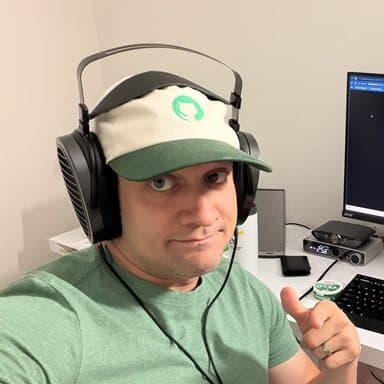
Vin Falkiewicz
Guitarist. Drummer. Spec-sheet skeptic.
Founder — Chord Lab
I'm Vin Falkiewicz, founder of Chord Lab. I've played guitar and drums since I was 12, and these days a lot of my playing happens with my two kids. My day job is data: I lead AI mobilization and data-driven solution development at EY, where I build and deploy the production AI systems large enterprises rely on — and the evaluation harnesses that prove whether any of it actually works.
Music gear is a strange market to shop in. Two instruments can share nearly identical spec sheets and feel completely different under your hands, because so much of what matters — the feel of a neck, the response of a pad, how a tone sits in a mix — is personal. And the most standard gear can carry wildly different price tags: a basic metronome and a premium one keep exactly the same time, yet one can cost ten times the other.
That's where data helps. Not by telling you how a guitar feels — nobody can do that for you — but by separating what can be checked (specs, features, real prices, what owners report over time) from what's marketing, so the time you spend trying gear in a store goes to a short list that deserves it.
So I'm building Chord Lab the way I'd build a system for a client. Every guide is being rebuilt on a catalog of real, verified product listings. Products are picked from that data by fixed rules weighted for the guide's use-case — a metal guitar and a blues guitar get judged on different things — and AI only turns the locked picks into readable prose. The rebuild is going category by category; until a guide has been rebuilt, it doesn't show prices, and its links send you to Amazon to see the current ones.
What I care about most: decisions should follow the evidence, not whoever wrote the loudest headline. The “we” here is me and that software pipeline — accountable to the data, and to me. My LinkedIn and inbox are public, and I'd love to hear what you play and what you think of the approach.
The short version of my resume
- Playing guitar and drums since age 12; now playing with my two kids
- AI Mobilization lead at EY, building and deploying production AI for Financial Services clients since 2022
- 10+ years at EY in Technology & Transformation (Senior Manager)
- Cornell University, B.A. Economics, 2011
- PMP (2020), Lean Six Sigma Green Belt (2018)
- 15+ years building data systems
- Site published by Falcon Analytics LLC (NJ), which I own
What you'll find here
- Buying guides organized around how you actually play — the right pick for one style can be the wrong one for another
- Real drawbacks for every pick, not just the highlights
- Guides being rebuilt on verified product data, category by category
What you won't find
- “Our luthiers tested 40 guitars in our studio” — I didn't, and I won't pretend otherwise
- Rankings shuffled to match whoever paid most — I take affiliate commissions (Amazon Associates) and disclose them, and they never move the rankings
- Paid placements disguised as editorial
- Made-up prices — until a price comes straight from a verified listing, you'll see a link to the current price on Amazon instead
How we make money
Chord Lab is reader-supported. As an Amazon Associate I earn from qualifying purchases: when you buy through our links, I earn a small commission at no extra cost to you. That's how the lights stay on.
Affiliate relationships never influence our rankings — commission rates play no part in how picks are chosen. I'd rather earn your trust over five years than your $7 commission this week. Read the full breakdown on our Affiliate Disclosure page.
Want the full methodology? Read how we review products →
— Vin